Last week we had work off for the Muslim holiday Eid al Adha (Festival
of Sacrifice). Eid al Adha is a celebration of when God asked Abraham
to sacrifice his son Ismael, and right before Abraham did so, God
intervened and said he could sacrifice a ram instead. Now it is
traditional for each family to slaughter a goat or sheep, uttering the
word "bismillah" before slitting its throat. They split the sheep
into three parts. One part is eaten by the immediate family, one goes
to the extended family, and the last is given to less fortunate
members of the community. It is essentially the middle eastern
version of Christmas, although the historical reasons for celebration
have nothing to do with each other. Everyone visits family, gives
presents, and eats lots of good food. My three month tourist visa was
on the verge of expiration so I had to use the week to leave the
country and hopefully get a new visa upon re-entry. Although it is
technically possible to get an extension at the ministries in Tel Aviv
or Jerusalem, it is very difficult for internationals who are not
actually tourists to use these offices. A couple of girls who are
part of our program recently went to the ministry of tourism office in
Jerusalem to try and renew their visas, and they were asked to prove
that they had stayed in hotels within Israel, and show that they had
reservations to do so in the future. After three days of arguing,
waiting, and trying to substantiate a fabricated story, they were
issued 2 week visas.
After hearing about this, a few of us decided to go to Jordan and
hopefully obtain an additional 3 month visa by simply crossing the
border, waiting 4 days, and re-entering. We started the journey at 8
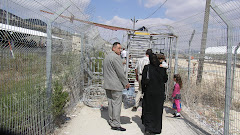
am last Sunday. When we arrived at Huwarra checkpoint, the sight of
short lines was a pleasant surprise. The previous three days at
Huwarra had been a madhouse. Two days before, the checkpoint had been
closed because settlers had come down from the hilltops and attacked
Palestinians, in what Israel's president described as modern day
"pogroms." The settlers had promised violence across the West Bank to
avenge the Israeli Army's eviction of settlers from a house in Hebron,
and they were making good on that promise. In the previous days
setters ransacked villages, burned cars and houses, and threw rocks at
passing cars and mini-buses. Dozens of people were injured, and a
number killed when their cars ran off the road following barrages of
stones. In this context, many people did not question the legitimacy
of the Israeli Army's claim that checkpoints were closed for security
reasons, but people also wondered why the army was so adept at
protecting the settlers, but utterly incapable of protecting the
Palestinians. Closing checkpoints during Eid al Adha proved to be an
especially volatile situation because thousands of Palestinians were
trying to leave the city to spend the holiday with family in nearby
villages. I'm sure you can imagine the frustration people in the US
would feel if all entry and exit to major cities was cut off during a
week before Christmas.
Anyways, the day before there had been hundreds of people waiting at
Huwarra. At times the Israelis stopped letting anyone through, and
after a bit people started to trickle through, only to stop again
shortly thereafter. As I reached the middle of the line, people in
the back started pushing against everyone in front. The Israeli
soldiers quickly raised the barrels of their guns to prevent a rush of
people coming towards them. Kids started screaming and crying because
they were being crushed between everyone, unable to push back.
Mothers with infants raised their children into the air to prevent
them from being smashed. One of the kids that was near me disappeared
from sight, and his father started yelling "Get back! You're going to
kill my son if you keep pushing." Elderly people tried to exit the
line, and they started to stream down the narrow channel separating
the concrete barrier from a high fence. A hunchbacked elderly lady
held onto the concrete barrier beside me and started walking towards
the front of the line. A soldier ran over and told her to stop. She
kept moving and the soldier raised his gun at her. I lost my temper
at started yelling at the soldier. "She's 80 years old and can hardly
walk, just let her through the fucking checkpoint." He gave me a
quizzical look, like I had no right to interfere, and started yelling
at me in Hebrew. Other soldiers started to walk over from the road
crossing. I started yelling back in English and pointing to the kids
that were being crushed by the mass of people. The second soldier was
much more reasonable, and he let some of the old people follow the
lady through the newly inaugurated checkpoint line. After three hours
at the checkpoint, we were allowed to pass. Getting back into Nablus
later that night proved to be another disaster. Settlers had gone on
another rampage shortly after we cleared the checkpoint, forcing the
IDF (Israeli Defense Forces) to shut the whole area down. We ended up
driving through olive groves and down dilapidated back roads because
soldiers closed all the main roads into Nablus. The bus driver
eventually convinced soldiers at a checkpoint reserved for truck
shipments to let the bus through.
The next day, the checkpoint was not crowded and passing through it
was not very difficult. We took a bus to Ramallah and then
Jerusalem. On the bus from Ramallah to Jerusalem we met an American
Palestinian girl who had just quit her job as a senior analyst in a
brokerage firm to come see her parents and try to find work with a
local NGO. We had a very interesting discussion with her, especially
concerning the treatment of women in Jordan and Palestine. The role
of women here is very complex, especially following the second
intifada. The middle east, and Palestine in particular, has become
increasingly religious and more "conservative" in the last decade.
Why this has occurred, I am not quite sure. One factor may be the
national identity crisis that many nations in the middle east have
gone through following the collapse of secular nationalist movements.
I think there are different factors in each country, but the emergence
of Islamic Nationalism seems to be the overarching theme. The word
"conservative" as it relates to women is most often used here as a
euphemism for the repression of women. When I lived in the states, I
thought of the hijab (Muslim head covering) as the symbol of a pattern
of repression. Most women in Nablus now wear the hijab, although
when you see pictures from Palestine 30 years ago, this dress is
noticeably lacking. Following lengthy discussion with women here, the
hijab seems to be a trivial issue. Every woman I have talked to
insists that she has chosen to wear it, in accordance with cultural
and religious traditions. The major issues they are concerned about
have to do with jobs, education, social discrimination, and marriage
inequality. Over 70% of the people going to the An Najah university,
where I teach professional development classes, are women. Women
comprise the vast majority of the people who graduate and do
exceedingly well academically, and yet they are openly discriminated
against in the job market. Frankly, work force discrimination against
women is rampant. They are asked questions in interviews that would
generate lawsuits in the US. I know many women with pharmaceutical
and other doctoral degrees who never anticipate being able to utilize
them. The traditional marriage engagement process merits an entire
discussion, and to put it gently, I think it's archaic. Living here
has certainly been a crash course in moral and cultural relativism.
Despite endless arguments by male friends, I still strongly disagree
with the notion that the repression of women is acceptable given the
"social context." The organization I work similarly holds that gender
discrimination is inexcusable, and we have a number of programs
designed to provide opportunities for women who would otherwise be
left out.
Anyways, we wished our new friend goodbye, and made our way across
Jerusalem to the central bus station. There are probably more guns in
the Jerusalem bus station than any other bus station on the planet.
Every third person in the station seemed to be carrying a weapon. We
had two hours to wait for our bus to the south of Israel, so I bought
a used book by a mountaineer who famously cut the rope of his partner
while climbing in Pakistan ("Into This Air," is the book by the guy
was cut off, a great book and movie if you get the chance to read it).
Eventually the bus came and as soon as the driver got out he seemed
like he was in a rush to leave. We walked on and asked him to drop us
off before Eliat, at the Yitzak Rabin border crossing. He curtly told
us that it would be a 45 minute walk from the highway to the border,
and advised us to go to Eliat and take a taxi instead. We insisted on
being let off at the crossing, and eventually he relented. Shortly
after parking, the bus was full, and about to be on its way. A woman
came out of the bus station, apparently pleading with the driver to
wait, as her husband was still inside the bus station. He told her
no, and she ran off the bus, frantically looking for her husband. The
bus driver started to pull away, you could see the woman in the
station shouting for her husband to hurry up. The bus started to
leave and the couple emerged from the bus station and started chasing
after it. The driver looked at them without remorse, he continued
driving until one of the station attendants put his hand out,
signaling for him to stop. Shortly after leaving the Jerusalem
proper, we entered the northern Negev desert. The side of the highway
was dotted with villages, the houses looked like temporary shelters.
The small communities looked more destitute than some of the refugee
camps. As we approached the Dead Sea, the bus driver started jamming
some Abba, we all watched him sing in the large rear view mirrors.
The bus driver stopped at a number of hotels along the Dead Sea, and
soon there were a number of people standing up. At the last stop some
old German tourists got on, and after no one offered their seat, my
Dutch colleague Truda and I let them sit in ours. Standing up felt
like a sickening version of surfing as the bus wound its way south on
the highway along the Dead Sea. Eventually we stopped at a rest stop
and everyone was allowed to get out for a few minutes. Five minutes
later the bus driver was telling everyone to get back on the bus. We
got on and the bus left almost immediately after. The bus driver
cruised past the bathrooms to give the occupants a cursory warning.
"Anybody in there, we're leaving" he said, honking, but not bothering
to stop. As we were about to turn onto the highway, he looked back
and said, "is everyone here?" Well everyone that's here is here,
everyone else is probably in the bathroom you just drove past.
Satisfied that his role call was complete, he turned back onto the
highway and continued south. to be continued.......
Sincerely
mike

Subscribe to:
Post Comments (Atom)
2 comments:
Hi Mike
I'm contacting you to ask permission to use your blog in a piece of research I am conducting about the experiences of Project Hope volunteers.
I would be really grateful if you could provide me with an email address that I could send a letter to that explains my project.
Best wishes,
Andy Gregory (fellow PH volunteer)
andgre@tinternet.com
Hi
I seem to be having problems with the email address. I can also be contacted at andgre2513@hotmail.com
Thanks,
Andy
Post a Comment