Ahlan wa Sahlan,
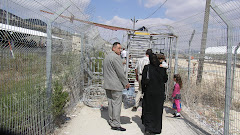
Last weekend a few of us went to pick olives with a guy named Bashar and his family in a small town called Beit Lid. The town is about 15 miles northwest of Nablus, not far from the "border" with Israel (border is in quotation marks because the placement of the line is very contentious, and is currently a dizzying series of zones, different colored lines, and special areas within zones). We arrived at the first checkpoint at about 8 in the morning. It's impossible to leave Nablus without going through a military checkpoint, and the vast majority of cars aren't allowed to drive through them, so you have to get out of the taxi or bus, walk through, and get a different one on the other side. It's difficult to feel comfortable going through the checkpoints. There are usually a number of soldiers, one checks your passport and asks questions while another points his M-16 at you. There are soldiers in squat sniper towers pointing larger weapons at you. All my life I learned to never point a weapon at anyone. Here I am, standing in front of a nervous 18 year old, finger on the trigger of a gun pointed at my chest. Not a fun place to be before your first cup of coffee. Adding to the fearful awkwardness of the situation is watching Palestinians get turned away. I've lived in this country for two weeks and I can go virtually anywhere with my tourist alibi. Behind me is a guy who's family has lived in a village outside Nablus for 5 generations, he's told he can't leave because his paperwork isn't valid on Jewish holidays.
The taxi ride to Beit Lit is about 15 more minutes, we wind through the town, and see our host Bashar waiting in the road. Bashar had a big hat and glasses on, he looked like a montana cowboy. Bashar was carrying a number of empty UN food aid bags, which we were apparently going to fill with olives. We walked down through a number of his neighbors olive groves to their family plot, they've got about 90 trees. We met his brother Ahmad, the father Majdee, and the mother Ayala. We shot the breeze for a while, had some arabic coffee, and started picking olives, letting them drop onto tarps surrounding the tree. After a few minutes the father came over to me with a big grin and explained a few things. He said "Look, at the end of the day the other villagers are going to ask us how many bags we filled and how many people we had. If I tell them we had 7 people and only filled 2 bags, we are going to be the laughing stock of the village." He then showed me how to properly pick olives, using either my hands or these branch combs. My speed increased exponentially. Things got fun fast. Soon we were singing, making jokes about politicians, and teaching our mother tongues to each other. Ahmad and Majdee taught me some great arabic phrases. They convinced me to yell "Habayba filaheen" (I love farmers) at passing villagers. Some of them looked at me like I was crazy, a few bent over laughing and shook their fists in the air. This ended unceremoniously when I accidentally left the "h" out of filaheen and apparently yelled "I love pimps."
Soon the father told us to stop working, and we all sat down for lunch. We each got a few pieces of pita to dip in the plethora of classic Arab dishes. Five hundred yards to the north one of the many illegal (according to both Israeli and international law) Israeli settlements was visible on the hill. Part of the reason we were picking olives in this town was because of it's proximity to this settlement. The week before settlers had come down, beat up a number of villagers and stole all the olives they harvested. The sight of internationals makes them less likely to come down because they know they're violent criminal behavior will be witnessed and might actually have repressions. There is a cruel paradox in the relationship between the Israeli military and the "settlers." The military is tasked with defending the settlers because they are technically Israeli citizens, but they cannot arrest the settlers, because in theory that is the job of the "police." There are no police in the settlements, because they are illegal, so the settlers can commit any imaginable criminal act, including kill Palestinians, with total immunity. Initially I was tempted to give the Israeli government the benefit of the doubt regarding this issue, thinking it was a bureaucratic glitch that needed to be worked out. I've since learned that the government gives the settlers military training and weapons (in addition to protection by the Israeli military) so they can "deal" with the Palestinians.
Things got a little wild that night, but it's getting late here and I have class early...I'll continue the story at some point. Hope things are well with all of you.
Best regards,
Mike

Subscribe to:
Post Comments (Atom)
No comments:
Post a Comment