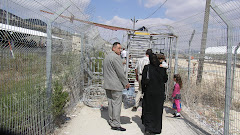
Picking olives the rest of the day was fairly uneventful. At one point Majdee asked me "do you think I'm a terrorist?" I obviously didn't, and was initially perplexed by the question. The Palestinians are well aware of the fact that they are demonized on news networks throughout the world. After reflecting on the question later, it seemed more genuine than provocative. To be honest, when I came here I expected to feel safe in Israel, and lingering in the back of my head was the fear that I might be kidnapped or shot by a Palestinian. The reality here has been the opposite. The Palestinians have been kind and welcoming beyond my wildest imagination. In every case they've gone out of their way to be hospitable and helpful. This was especially true after I poisoned myself with the can of raid (great for killing mosquitoes and white blood cells). A refugee named Mohamed heard me coughing badly as I walked back from the other side of town. He invited me into his shelter, using his last bottles of fresh water to make me tea with lemon and sage. Everyday I am showered with acts of generosity by people who are much less fortunate than myself. The dangerous situations have all involved Israeli settlers and soldiers. The settlers and often the Israeli military are the real terrorists in this situation. Every single day they terrorize innocent Palestinians throughout the West Bank. In a town south of here called Hebron, the settlers commit unconscionable acts. For the past 4 years, settlers have come to a road where Palestinian children (8-14 years old) walk home from school and thrown stones or fired guns at them. So many Palestinian kids were getting badly injured or killed that they stopped going to school. Eventually the mayor of Hebron convinced the Israeli army to escort the kids home so they could continue their education. Yesterday the Israeli army decided it had better things to do. Settlers waited for the kids to get out of school and stoned the children as they tried to walk home. Can you imagine, grown men hurling rocks at small girls and boys? The most unsettling thing about being an american here is that my tax dollars are being used to protect and arm these relentlessly cruel thugs. The Palestinian market in Hebron has a big mesh wire net over it because the 300 illegal settlers that live in the town throw everything imaginable (rocks, bricks, feces, ...) at Palestinians shopping in the market below. In this case (mesh wiring) the Israeli government at least decided to do something about the symptom of the problem, Palestinians being injured and killed by projectiles hurled by Israeli citizens. Addressing the cause of the problem, violent Israeli settlers taking over the West Bank, is not being considered. If the US threatened to withdraw its annual 3 billion dollar aid package to Israel (some of the money is going directly to these settlers, most is going to the military, which protects them), the situation would change overnight. American voters make all the difference in this regard.
Shortly after lunch the father Majdee received a call from his his brother, his mother had gone unconscious. Majdee ran into town to the house where his mother was to see what was happening. Majdee's mom has cancer in her stomache, and she has been sick for quite some time. The hospital in Tulkarem, a nearby town, didn't have the facilities or medicine to cure the cancer, or ease the pain associated with this particular affliction. The family couldn't obtain the permits necessary to bring her through the checkpoints into Nablus, to a better equipped hospital. Even if they had obtained the permits, Majdee was terrified of taking his mother in her delicate condition to the Israeli checkpoint only to get harassed and have his mom die in an ambulance surrounded by hostile soldiers with guns asking questions. Soon Majdee came back and said his mom had regained consciousness.
At the end of the day, we packed our two 60 kilo sacks of olives on Hero the donkey. Ahmad, Majdee, Hero and I took the bags to a nearby tractor owned by another villager, and he drove them the rest of the way up to the village. We then harnessed Hero up and attached a cart made of wood and a shortened car axle with tires. The donkey was very familiar with the way and made a very difficult trail look easy. While we were picking olives that day one of the antiquated tarps ripped and made collecting the olives a very slow going process. I asked Majdee if I could buy him another tarp in town, he reluctantly agreed, and that evening we went into the village. Majdee first showed Maxime (a french volunteer) and I the villages recently purchased Italian olive oil press. It was quite an amazing machine and was situated next the the villages old olive oil press, a massive stone moved by a team of donkeys. The owners of the machine keep 1 litre of oil for every 14 produced. We then went to the hardware store to find a tarp. The small room was filled with Palestinian men, and we soon found out they were out of tarps. The men were all trying to talk to me, and I did my best to respond in broken Arabic. It's especially difficult to communicate in the villages because their dialect is very different from Fusa, or standard arabic. There was one guy at the door who was particularly interested in talking to us. When he saw his message wasn't getting across he pointed to his worn out shoes. Then he showed us his worn out shirt. He then started to unbuckle his belt, unzipped his pants, and pulled them down to his knees. Maxime and I were still looking at him, not knowing what he was trying to show us. When we saw that he wasn't wearing any underwear, we turned to our host, partly to figure out what was going on, and partly because we we're particularly interested in looking at the old mans penis. By the time we turned around to ask Majdee what was going on, he was yelling at the guy in arabic. We said goodbye to the men and Majdee apologized, explaining that the man was trying to show us that he was so broke he couldn't even afford underwear. I guess that's one way to overcome the language barrier. The next store we went to had tarps, and I got a couple for Majdee. We then went to see his mother.
When we arrived his mom was lying in a room with four other men drinking tea at her bedside. Majdee went over, held his mom's hand and spoke to her for a while. She was writhing in pain on the bed. There was no medical equipment, but one of the men was a local doctor. We stayed for about half an hour and then left. We stopped at two more stores because Majdee had to buy hummus and cigarettes. In both places the people were eager to talk to us, and insisted we take something from the store on the house. We went home and ate a wonderful dinner that Ayala had prepared. There was a little food left and I was still hungry, but if you eat everything at a Palestinian hosts house they feel as if you're still unsatisfied, and will go to any length to make sure you're full. After dinner I started talking to Majdee about Islam, and he was about to explain how to pray, and what the motions meant. He faced a strip of tape on the wall that indicated the direction of Mecca, the orientation all Muslims establish when they pray. All of a sudden a french volunteer, Joanna, who is often obnoxious, told the father "that's not where Mecca is...if Tel aviv is that direction, then Mecca must be somewhere over there." I was speechless, shocked, embarrassed. Majdee politely explained, "Well that's the direction all of our mosques point, that's the direction my grandfather faced when he prayed, and that's the direction I've prayed for my entire life." In her typical fashion she was unrelenting. I'm ashamed for not pulling her out of the room and reading her the riot act, but I was in such disbelief I didn't know what to do. Majdee is a 60 year old man who's dealt with much worse than this abrasive foreigner, and was able to make light of the situation.
We woke up early the next morning and went down to their olive grove. We chatted a little but we were really trying to fill 6 bags, 3 times the amount we picked the previous day. A few hours after we started picking Majdee got another call from his bother, his mother was unconscious again. Majdee's back was hurting badly, so he rode Hero the donkey into town. Soon after Bashar told us to stop picking olives. He had received a call from his father, Majdee informed him that his grandma was dead. Bashar, Ahmad, and Ayala were heartbroken. Bashar said that we should probably head back to Nablus as the family had to prepare for the burial ceremony. We offered our condolences and they insisted on feeding us something before we left. Bashar continued to thank us for coming out and apologized for the circumstances. We begged him not to apologize. He walked us to the village and we caught a taxi back to Nablus.
Sincerely,
Mike
ps-please write your representatives about the settler and aid issue, the money we are giving Israel each year is being used in appaling ways.

Subscribe to:
Post Comments (Atom)
No comments:
Post a Comment