Picking olives the rest of the day was fairly uneventful. At one point Majdee asked me "do you think I'm a terrorist?" I obviously didn't, and was initially perplexed by the question. The Palestinians are well aware of the fact that they are demonized on news networks throughout the world. After reflecting on the question later, it seemed more genuine than provocative. To be honest, when I came here I expected to feel safe in Israel, and lingering in the back of my head was the fear that I might be kidnapped or shot by a Palestinian. The reality here has been the opposite. The Palestinians have been kind and welcoming beyond my wildest imagination. In every case they've gone out of their way to be hospitable and helpful. This was especially true after I poisoned myself with the can of raid (great for killing mosquitoes and white blood cells). A refugee named Mohamed heard me coughing badly as I walked back from the other side of town. He invited me into his shelter, using his last bottles of fresh water to make me tea with lemon and sage. Everyday I am showered with acts of generosity by people who are much less fortunate than myself. The dangerous situations have all involved Israeli settlers and soldiers. The settlers and often the Israeli military are the real terrorists in this situation. Every single day they terrorize innocent Palestinians throughout the West Bank. In a town south of here called Hebron, the settlers commit unconscionable acts. For the past 4 years, settlers have come to a road where Palestinian children (8-14 years old) walk home from school and thrown stones or fired guns at them. So many Palestinian kids were getting badly injured or killed that they stopped going to school. Eventually the mayor of Hebron convinced the Israeli army to escort the kids home so they could continue their education. Yesterday the Israeli army decided it had better things to do. Settlers waited for the kids to get out of school and stoned the children as they tried to walk home. Can you imagine, grown men hurling rocks at small girls and boys? The most unsettling thing about being an american here is that my tax dollars are being used to protect and arm these relentlessly cruel thugs. The Palestinian market in Hebron has a big mesh wire net over it because the 300 illegal settlers that live in the town throw everything imaginable (rocks, bricks, feces, ...) at Palestinians shopping in the market below. In this case (mesh wiring) the Israeli government at least decided to do something about the symptom of the problem, Palestinians being injured and killed by projectiles hurled by Israeli citizens. Addressing the cause of the problem, violent Israeli settlers taking over the West Bank, is not being considered. If the US threatened to withdraw its annual 3 billion dollar aid package to Israel (some of the money is going directly to these settlers, most is going to the military, which protects them), the situation would change overnight. American voters make all the difference in this regard.
Shortly after lunch the father Majdee received a call from his his brother, his mother had gone unconscious. Majdee ran into town to the house where his mother was to see what was happening. Majdee's mom has cancer in her stomache, and she has been sick for quite some time. The hospital in Tulkarem, a nearby town, didn't have the facilities or medicine to cure the cancer, or ease the pain associated with this particular affliction. The family couldn't obtain the permits necessary to bring her through the checkpoints into Nablus, to a better equipped hospital. Even if they had obtained the permits, Majdee was terrified of taking his mother in her delicate condition to the Israeli checkpoint only to get harassed and have his mom die in an ambulance surrounded by hostile soldiers with guns asking questions. Soon Majdee came back and said his mom had regained consciousness.
At the end of the day, we packed our two 60 kilo sacks of olives on Hero the donkey. Ahmad, Majdee, Hero and I took the bags to a nearby tractor owned by another villager, and he drove them the rest of the way up to the village. We then harnessed Hero up and attached a cart made of wood and a shortened car axle with tires. The donkey was very familiar with the way and made a very difficult trail look easy. While we were picking olives that day one of the antiquated tarps ripped and made collecting the olives a very slow going process. I asked Majdee if I could buy him another tarp in town, he reluctantly agreed, and that evening we went into the village. Majdee first showed Maxime (a french volunteer) and I the villages recently purchased Italian olive oil press. It was quite an amazing machine and was situated next the the villages old olive oil press, a massive stone moved by a team of donkeys. The owners of the machine keep 1 litre of oil for every 14 produced. We then went to the hardware store to find a tarp. The small room was filled with Palestinian men, and we soon found out they were out of tarps. The men were all trying to talk to me, and I did my best to respond in broken Arabic. It's especially difficult to communicate in the villages because their dialect is very different from Fusa, or standard arabic. There was one guy at the door who was particularly interested in talking to us. When he saw his message wasn't getting across he pointed to his worn out shoes. Then he showed us his worn out shirt. He then started to unbuckle his belt, unzipped his pants, and pulled them down to his knees. Maxime and I were still looking at him, not knowing what he was trying to show us. When we saw that he wasn't wearing any underwear, we turned to our host, partly to figure out what was going on, and partly because we we're particularly interested in looking at the old mans penis. By the time we turned around to ask Majdee what was going on, he was yelling at the guy in arabic. We said goodbye to the men and Majdee apologized, explaining that the man was trying to show us that he was so broke he couldn't even afford underwear. I guess that's one way to overcome the language barrier. The next store we went to had tarps, and I got a couple for Majdee. We then went to see his mother.
When we arrived his mom was lying in a room with four other men drinking tea at her bedside. Majdee went over, held his mom's hand and spoke to her for a while. She was writhing in pain on the bed. There was no medical equipment, but one of the men was a local doctor. We stayed for about half an hour and then left. We stopped at two more stores because Majdee had to buy hummus and cigarettes. In both places the people were eager to talk to us, and insisted we take something from the store on the house. We went home and ate a wonderful dinner that Ayala had prepared. There was a little food left and I was still hungry, but if you eat everything at a Palestinian hosts house they feel as if you're still unsatisfied, and will go to any length to make sure you're full. After dinner I started talking to Majdee about Islam, and he was about to explain how to pray, and what the motions meant. He faced a strip of tape on the wall that indicated the direction of Mecca, the orientation all Muslims establish when they pray. All of a sudden a french volunteer, Joanna, who is often obnoxious, told the father "that's not where Mecca is...if Tel aviv is that direction, then Mecca must be somewhere over there." I was speechless, shocked, embarrassed. Majdee politely explained, "Well that's the direction all of our mosques point, that's the direction my grandfather faced when he prayed, and that's the direction I've prayed for my entire life." In her typical fashion she was unrelenting. I'm ashamed for not pulling her out of the room and reading her the riot act, but I was in such disbelief I didn't know what to do. Majdee is a 60 year old man who's dealt with much worse than this abrasive foreigner, and was able to make light of the situation.
We woke up early the next morning and went down to their olive grove. We chatted a little but we were really trying to fill 6 bags, 3 times the amount we picked the previous day. A few hours after we started picking Majdee got another call from his bother, his mother was unconscious again. Majdee's back was hurting badly, so he rode Hero the donkey into town. Soon after Bashar told us to stop picking olives. He had received a call from his father, Majdee informed him that his grandma was dead. Bashar, Ahmad, and Ayala were heartbroken. Bashar said that we should probably head back to Nablus as the family had to prepare for the burial ceremony. We offered our condolences and they insisted on feeding us something before we left. Bashar continued to thank us for coming out and apologized for the circumstances. We begged him not to apologize. He walked us to the village and we caught a taxi back to Nablus.
Sincerely,
Mike
ps-please write your representatives about the settler and aid issue, the money we are giving Israel each year is being used in appaling ways.
Wednesday, December 17, 2008

Picking Olives in Beit Lid
Ahlan wa Sahlan,
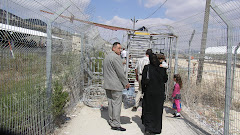
Last weekend a few of us went to pick olives with a guy named Bashar and his family in a small town called Beit Lid. The town is about 15 miles northwest of Nablus, not far from the "border" with Israel (border is in quotation marks because the placement of the line is very contentious, and is currently a dizzying series of zones, different colored lines, and special areas within zones). We arrived at the first checkpoint at about 8 in the morning. It's impossible to leave Nablus without going through a military checkpoint, and the vast majority of cars aren't allowed to drive through them, so you have to get out of the taxi or bus, walk through, and get a different one on the other side. It's difficult to feel comfortable going through the checkpoints. There are usually a number of soldiers, one checks your passport and asks questions while another points his M-16 at you. There are soldiers in squat sniper towers pointing larger weapons at you. All my life I learned to never point a weapon at anyone. Here I am, standing in front of a nervous 18 year old, finger on the trigger of a gun pointed at my chest. Not a fun place to be before your first cup of coffee. Adding to the fearful awkwardness of the situation is watching Palestinians get turned away. I've lived in this country for two weeks and I can go virtually anywhere with my tourist alibi. Behind me is a guy who's family has lived in a village outside Nablus for 5 generations, he's told he can't leave because his paperwork isn't valid on Jewish holidays.
The taxi ride to Beit Lit is about 15 more minutes, we wind through the town, and see our host Bashar waiting in the road. Bashar had a big hat and glasses on, he looked like a montana cowboy. Bashar was carrying a number of empty UN food aid bags, which we were apparently going to fill with olives. We walked down through a number of his neighbors olive groves to their family plot, they've got about 90 trees. We met his brother Ahmad, the father Majdee, and the mother Ayala. We shot the breeze for a while, had some arabic coffee, and started picking olives, letting them drop onto tarps surrounding the tree. After a few minutes the father came over to me with a big grin and explained a few things. He said "Look, at the end of the day the other villagers are going to ask us how many bags we filled and how many people we had. If I tell them we had 7 people and only filled 2 bags, we are going to be the laughing stock of the village." He then showed me how to properly pick olives, using either my hands or these branch combs. My speed increased exponentially. Things got fun fast. Soon we were singing, making jokes about politicians, and teaching our mother tongues to each other. Ahmad and Majdee taught me some great arabic phrases. They convinced me to yell "Habayba filaheen" (I love farmers) at passing villagers. Some of them looked at me like I was crazy, a few bent over laughing and shook their fists in the air. This ended unceremoniously when I accidentally left the "h" out of filaheen and apparently yelled "I love pimps."
Soon the father told us to stop working, and we all sat down for lunch. We each got a few pieces of pita to dip in the plethora of classic Arab dishes. Five hundred yards to the north one of the many illegal (according to both Israeli and international law) Israeli settlements was visible on the hill. Part of the reason we were picking olives in this town was because of it's proximity to this settlement. The week before settlers had come down, beat up a number of villagers and stole all the olives they harvested. The sight of internationals makes them less likely to come down because they know they're violent criminal behavior will be witnessed and might actually have repressions. There is a cruel paradox in the relationship between the Israeli military and the "settlers." The military is tasked with defending the settlers because they are technically Israeli citizens, but they cannot arrest the settlers, because in theory that is the job of the "police." There are no police in the settlements, because they are illegal, so the settlers can commit any imaginable criminal act, including kill Palestinians, with total immunity. Initially I was tempted to give the Israeli government the benefit of the doubt regarding this issue, thinking it was a bureaucratic glitch that needed to be worked out. I've since learned that the government gives the settlers military training and weapons (in addition to protection by the Israeli military) so they can "deal" with the Palestinians.
Things got a little wild that night, but it's getting late here and I have class early...I'll continue the story at some point. Hope things are well with all of you.
Best regards,
Mike
Last weekend a few of us went to pick olives with a guy named Bashar and his family in a small town called Beit Lid. The town is about 15 miles northwest of Nablus, not far from the "border" with Israel (border is in quotation marks because the placement of the line is very contentious, and is currently a dizzying series of zones, different colored lines, and special areas within zones). We arrived at the first checkpoint at about 8 in the morning. It's impossible to leave Nablus without going through a military checkpoint, and the vast majority of cars aren't allowed to drive through them, so you have to get out of the taxi or bus, walk through, and get a different one on the other side. It's difficult to feel comfortable going through the checkpoints. There are usually a number of soldiers, one checks your passport and asks questions while another points his M-16 at you. There are soldiers in squat sniper towers pointing larger weapons at you. All my life I learned to never point a weapon at anyone. Here I am, standing in front of a nervous 18 year old, finger on the trigger of a gun pointed at my chest. Not a fun place to be before your first cup of coffee. Adding to the fearful awkwardness of the situation is watching Palestinians get turned away. I've lived in this country for two weeks and I can go virtually anywhere with my tourist alibi. Behind me is a guy who's family has lived in a village outside Nablus for 5 generations, he's told he can't leave because his paperwork isn't valid on Jewish holidays.
The taxi ride to Beit Lit is about 15 more minutes, we wind through the town, and see our host Bashar waiting in the road. Bashar had a big hat and glasses on, he looked like a montana cowboy. Bashar was carrying a number of empty UN food aid bags, which we were apparently going to fill with olives. We walked down through a number of his neighbors olive groves to their family plot, they've got about 90 trees. We met his brother Ahmad, the father Majdee, and the mother Ayala. We shot the breeze for a while, had some arabic coffee, and started picking olives, letting them drop onto tarps surrounding the tree. After a few minutes the father came over to me with a big grin and explained a few things. He said "Look, at the end of the day the other villagers are going to ask us how many bags we filled and how many people we had. If I tell them we had 7 people and only filled 2 bags, we are going to be the laughing stock of the village." He then showed me how to properly pick olives, using either my hands or these branch combs. My speed increased exponentially. Things got fun fast. Soon we were singing, making jokes about politicians, and teaching our mother tongues to each other. Ahmad and Majdee taught me some great arabic phrases. They convinced me to yell "Habayba filaheen" (I love farmers) at passing villagers. Some of them looked at me like I was crazy, a few bent over laughing and shook their fists in the air. This ended unceremoniously when I accidentally left the "h" out of filaheen and apparently yelled "I love pimps."
Soon the father told us to stop working, and we all sat down for lunch. We each got a few pieces of pita to dip in the plethora of classic Arab dishes. Five hundred yards to the north one of the many illegal (according to both Israeli and international law) Israeli settlements was visible on the hill. Part of the reason we were picking olives in this town was because of it's proximity to this settlement. The week before settlers had come down, beat up a number of villagers and stole all the olives they harvested. The sight of internationals makes them less likely to come down because they know they're violent criminal behavior will be witnessed and might actually have repressions. There is a cruel paradox in the relationship between the Israeli military and the "settlers." The military is tasked with defending the settlers because they are technically Israeli citizens, but they cannot arrest the settlers, because in theory that is the job of the "police." There are no police in the settlements, because they are illegal, so the settlers can commit any imaginable criminal act, including kill Palestinians, with total immunity. Initially I was tempted to give the Israeli government the benefit of the doubt regarding this issue, thinking it was a bureaucratic glitch that needed to be worked out. I've since learned that the government gives the settlers military training and weapons (in addition to protection by the Israeli military) so they can "deal" with the Palestinians.
Things got a little wild that night, but it's getting late here and I have class early...I'll continue the story at some point. Hope things are well with all of you.
Best regards,
Mike
Palestinian Wedding
Sabah al Noor everyone,
Quote of the day: Simon (a scottish volunteer): "Tamer, what are all these bugs in our beds?" Tamer (Volunteer coordinator): "Oh those are mosquitos." Simon: "Last time I checked mosquitos don't live on cats."
Apparently some of the previous volunteers felt sorry for all the feral cats so they took it upon themselves to feed them...in our flat. Every night as we go to sleep these mystery bugs start biting us. Last night I got so mad at them I took the can of raid that I purchased and sprayed it on myself. Not a good idea, my throat feels like I swallowed a bag of small nails.
The first night in Nablus we were invited to the wedding of a Palestinian volunteer. We arrived and there was a large crowd of Palestinians mingling. After a few minutes of chatting and introductions we ascended a staircase, everyone was clapping and singing a traditional Palestinian song. At the top of the stairs we all danced into a reception area filled with somber looking women in Hijabs (covers everything but face). We continued singing and clapping for a while until a few guys motioned for us to go into another room. The men sat in a big circle where everyone chainsmoked, drank lemonade, and ate cake. The groom came around and talked to every person, kissing most people on the cheek a number of times. The entire time what sounded like modern Arabic pop songs were playing. I later learned from the female volunteers that when the men left the room, the women absolutely cut loose. The expressionless women we saw just minutes before bellydanced, sprayed foam guns at eachother, and pretty much just went wild. After some time the men were told to re-enter the room, where once again the women sat expressionless. All the men entered the room clapping and dancing. They all danced in line as they waited their turn to pin money on the grooms chest. When they were done pinning money on the groom the men stayed at the front of the room and started dancing. A few of us soon joined them. Some of the dances were really easy to learn, others, like the Palestinian national dance "al dhabka," were more difficult. When I say dance, I don't mean like an awkward sober american, these guys could give J Lo a run for her money. They took turns getting in the middle of a circle we had formed and would stick their arms out and shake thier butts for all they were worth. These guys were grinding on eachother, throwing people into the air, and jumping around in what sometimes felt like a mash pit. I've been to a lot of clubs and never seen anyone dance like the Palestinians. Frankly, I was flabbergasted that this was the norm in a society that is otherwise very conservative. After about an hour of this we retired to the back of the room and once again began to sing and clap. I'm told that usually the dancing lasts much longer but everyone had to make it home before the 11 o'clock curfew imposed by the Israelis.
Maa Salama,
Mike
Quote of the day: Simon (a scottish volunteer): "Tamer, what are all these bugs in our beds?" Tamer (Volunteer coordinator): "Oh those are mosquitos." Simon: "Last time I checked mosquitos don't live on cats."
Apparently some of the previous volunteers felt sorry for all the feral cats so they took it upon themselves to feed them...in our flat. Every night as we go to sleep these mystery bugs start biting us. Last night I got so mad at them I took the can of raid that I purchased and sprayed it on myself. Not a good idea, my throat feels like I swallowed a bag of small nails.
The first night in Nablus we were invited to the wedding of a Palestinian volunteer. We arrived and there was a large crowd of Palestinians mingling. After a few minutes of chatting and introductions we ascended a staircase, everyone was clapping and singing a traditional Palestinian song. At the top of the stairs we all danced into a reception area filled with somber looking women in Hijabs (covers everything but face). We continued singing and clapping for a while until a few guys motioned for us to go into another room. The men sat in a big circle where everyone chainsmoked, drank lemonade, and ate cake. The groom came around and talked to every person, kissing most people on the cheek a number of times. The entire time what sounded like modern Arabic pop songs were playing. I later learned from the female volunteers that when the men left the room, the women absolutely cut loose. The expressionless women we saw just minutes before bellydanced, sprayed foam guns at eachother, and pretty much just went wild. After some time the men were told to re-enter the room, where once again the women sat expressionless. All the men entered the room clapping and dancing. They all danced in line as they waited their turn to pin money on the grooms chest. When they were done pinning money on the groom the men stayed at the front of the room and started dancing. A few of us soon joined them. Some of the dances were really easy to learn, others, like the Palestinian national dance "al dhabka," were more difficult. When I say dance, I don't mean like an awkward sober american, these guys could give J Lo a run for her money. They took turns getting in the middle of a circle we had formed and would stick their arms out and shake thier butts for all they were worth. These guys were grinding on eachother, throwing people into the air, and jumping around in what sometimes felt like a mash pit. I've been to a lot of clubs and never seen anyone dance like the Palestinians. Frankly, I was flabbergasted that this was the norm in a society that is otherwise very conservative. After about an hour of this we retired to the back of the room and once again began to sing and clap. I'm told that usually the dancing lasts much longer but everyone had to make it home before the 11 o'clock curfew imposed by the Israelis.
Maa Salama,
Mike
The Forgotten Refugees
The Forgotten Refugees
Imagine for a minute a different hometown. The grocery store is gone. You beg aid workers to throw a bag of flour your way from the truck. If you misbehave, nothing will come, except bombs, but they come anyways. A couple miles away a friend is hosting a dinner. It doesn't start until this evening, but you leave at 9 am to give yourself time to negotiate the military checkpoints. After enduring hours of harassment by soldiers you finally make it to the meal. Want to get some fresh air outside after dinner? Don't bother, it's past curfew, any breath out there may be your last. Certainly don't go outside to smoke, snipers use the glow at the end of the cigarette to locate your head. That night you wake up to the sound of the neighbors door being smashed. The father and sons you ate with the night before have been taken to prison for an indefinite amount of time on unspecified charges. The wife and daughters can still be heard crying in the morning. Another day of travel through the ancient militarized landscape and eventually you arrive at your pockmarked concrete shelter.
You open your door and find a letter from a prestigious European university. It's an acceptance letter for the program you applied to, you've even received a full scholarship! Studying abroad is going to be a life altering experience. Finally you'll be able to escape this existence, a way of life no human being should have to endure. The next day you apply for a student visa. You're told you can't leave because you pose a security threat. "But I'm just a student, desperate for a secondary education" you argue, "I wouldn't ever dream of harming anyone." Your protests fall on deaf ears. "Try again next year" the consulate officer tells you, "Next please." "My parents have been festering in this refugee camp for 60 years" you tell them as they shoo you away, "for the love of god please let me out." You're dragged out by two security officers and told to never come back.
Sweltering heat and the sound of distant gunshots wake you up the next morning. You eat a small meal and grab you lesson plan before heading off to the elementary school where you tutor. As you walk along the security fence, a large concrete barrier lined with concertina wire, you think about what life might be like outside. As you look past the sewage running through the streets and glimpse through the separation barrier you can see state of the art cities, glistening with technology, and human dignity. Kids on the other side of the barrier spend their afternoons swimming in pristine pools and playing normal kid games. The only children you know walk around destitute , looking for stones to throw at the tanks that drive dangerously close to them. Sometimes the tanks reciprocate. Instead of going to time-out, kids are ripped apart by tank shells or .50 caliber machine gun bullets. The tanks don't stop, they don't even open the hatch to hear the child's blood curdling screams. The kids stay behind, holding their friend. "I'll never throw another rock" the child promises. Soon the child will be dead, the family will mourn, no one will be held accountable.
Welcome to life as a Palestinian refugee. There are 4,618,141 of them. They live in some of the worst conditions on the planet. Most families have spent the last sixty years unable to leave their small, overcrowded, extremely impoverished camps. Their lives are defined by despair, anger, and hopelessness. If one fights back, they are all crushed. If they hold elections, they are divided and conquered. If they stand aside and watch their homes, family, and society be destroyed, they are not spared. The bill is picked up by our collective tax dollars.
What can you do?
Write your senators and congressmen/women and tell them no more illegal Israeli settlements.
Tell them you want the annual 3 billion dollar gift to the Israelis cut off until an equitable solution is agreed upon.
Urge your representatives to pressure the Israelis into letting out 689 students who have currently been accepted to university programs but whom are unable to leave.
Educate yourself about the Israeli occupation, because the press has apologetically abrogated their responsibility on this issue.
Imagine for a minute a different hometown. The grocery store is gone. You beg aid workers to throw a bag of flour your way from the truck. If you misbehave, nothing will come, except bombs, but they come anyways. A couple miles away a friend is hosting a dinner. It doesn't start until this evening, but you leave at 9 am to give yourself time to negotiate the military checkpoints. After enduring hours of harassment by soldiers you finally make it to the meal. Want to get some fresh air outside after dinner? Don't bother, it's past curfew, any breath out there may be your last. Certainly don't go outside to smoke, snipers use the glow at the end of the cigarette to locate your head. That night you wake up to the sound of the neighbors door being smashed. The father and sons you ate with the night before have been taken to prison for an indefinite amount of time on unspecified charges. The wife and daughters can still be heard crying in the morning. Another day of travel through the ancient militarized landscape and eventually you arrive at your pockmarked concrete shelter.
You open your door and find a letter from a prestigious European university. It's an acceptance letter for the program you applied to, you've even received a full scholarship! Studying abroad is going to be a life altering experience. Finally you'll be able to escape this existence, a way of life no human being should have to endure. The next day you apply for a student visa. You're told you can't leave because you pose a security threat. "But I'm just a student, desperate for a secondary education" you argue, "I wouldn't ever dream of harming anyone." Your protests fall on deaf ears. "Try again next year" the consulate officer tells you, "Next please." "My parents have been festering in this refugee camp for 60 years" you tell them as they shoo you away, "for the love of god please let me out." You're dragged out by two security officers and told to never come back.
Sweltering heat and the sound of distant gunshots wake you up the next morning. You eat a small meal and grab you lesson plan before heading off to the elementary school where you tutor. As you walk along the security fence, a large concrete barrier lined with concertina wire, you think about what life might be like outside. As you look past the sewage running through the streets and glimpse through the separation barrier you can see state of the art cities, glistening with technology, and human dignity. Kids on the other side of the barrier spend their afternoons swimming in pristine pools and playing normal kid games. The only children you know walk around destitute , looking for stones to throw at the tanks that drive dangerously close to them. Sometimes the tanks reciprocate. Instead of going to time-out, kids are ripped apart by tank shells or .50 caliber machine gun bullets. The tanks don't stop, they don't even open the hatch to hear the child's blood curdling screams. The kids stay behind, holding their friend. "I'll never throw another rock" the child promises. Soon the child will be dead, the family will mourn, no one will be held accountable.
Welcome to life as a Palestinian refugee. There are 4,618,141 of them. They live in some of the worst conditions on the planet. Most families have spent the last sixty years unable to leave their small, overcrowded, extremely impoverished camps. Their lives are defined by despair, anger, and hopelessness. If one fights back, they are all crushed. If they hold elections, they are divided and conquered. If they stand aside and watch their homes, family, and society be destroyed, they are not spared. The bill is picked up by our collective tax dollars.
What can you do?
Write your senators and congressmen/women and tell them no more illegal Israeli settlements.
Tell them you want the annual 3 billion dollar gift to the Israelis cut off until an equitable solution is agreed upon.
Urge your representatives to pressure the Israelis into letting out 689 students who have currently been accepted to university programs but whom are unable to leave.
Educate yourself about the Israeli occupation, because the press has apologetically abrogated their responsibility on this issue.
Friday, October 3, 2008
Ancient Warning System
Riding the train from Tel Aviv to Jerusalem I sat across from a 22 year old Lietenant in the Israeli army. He was very nice and we had an interesting discussion about how fast kids in Israel have to grow up because of the mandatory military service beginning at age 18. I thought about this fact at the Tel Aviv train station as I watched tons of kids that looked like they were still in high school carrying around automatic weapons. The train sped through farmland outside Tel Aviv and soon began to wind up the hills in the Jerusalem heights. The climb up to Jerusalem was gorgeous and the hills were filled with olive orchards. A number of the orchards had been cut down, one of the many ways of punishing Palestinians for bad behavior.
I caught a taxi at the end of the line outside of Jerusalem and rode to the Damascus gate in the Muslim quarter with a fellow named Lulu. The Damascus gate is one of seven entrances to the old city (I've heard different numbers but Lulu assured me he was correct). His driving made me think he had a death wish. I immediately put my seatbelt on and cluthched the o shit handle until the end of the ride. Twenty shekels later I was outside the towering walls of the Old City. I asked some arabs drinking turkish coffee how to get to the bus station and they directed me down a narrow alley. I found the bus to Ramallah, put my bag in the back and took my seat. I started a conversation with a little girl in broken arabic and soon remembered that talking to a girls who I'm not related to is haram (forbidden). The bus wound through the hills outside Jerusalem towards the unofficial Palestinian capital Ramallah. We drove along the seperation barrier for a few miles and eventually went through a number of military checkpoints. Snipers in towers pointed their weapons at every passing car, a very eerie feeling. Eventually we arrived at an underground bus station next to a crowded marketplace. The first guy I asked for directions had mental issues, but some nice old men saw the problem and pointed me to the Huwarra checkpoint bus. You cannot drive or take a bus all the way to Nablus, you have to get off at the checkpoint, walk through, and take another bus. As I was sitting down I dropped a shekel (about 30 cents) and it rolled to the back of the bus. Distracted and a bit nervous I didn't go to retrieve it. A couple minutes later a little girl tapped me on the shoulder and handed it back. The small gesture broke my heart. Here is a girl whose parents were probably either unemployed or living in poverty, partly because of policies supported by my country, and she retrieved and returned my shekel. I cannot begin to articulate how kind and generous Palestininas have been to me, even after finding out I'm from America.
It was not difficult to cross the Huwarra checkpoint into Nablus but there were hundreds of people waiting to get out, most of them get refused, even with all the proper permits and paperwork. I rode in a shared taxi to the Funduq al Yasmeen (yasmeen hotel) in downtown Nablus. As I got out a kid ran down the stairs. He went to grab my bag and I explained that I just needed to make a phone call. He replied in broken english, “I know, we called Hasan, he's on his way to get you.” We walked up through a maze of stone hallways filled with ancient looking columns. The place looked and felt sort of like an mc escher drawing.
Hasan soon arrived and we drove to the volunteer flat and Porject Hope office. I signed some papers and met most of the other volunteers. Our flat is like an international commune. Volunteers came from france, holland, iceland, belgium, california, scotland, and norway. The flat is located midway up the hills overlooking Nablus. Atop the adjacent hills sits an Israeli patriot missle base and another large military base. At night you can watch military vehicals winding down the switchbacks to conduct raids. With the infrared feature activated on video camras you can see which houses have been “painted” that night for invasion. Nablus has a sort of ancient warning system. When the army comes down for raids all the dogs start barking, which wakes up the roosters. Within minutes the entire town is enveloped in a symphony of barking, cuckooing, and small arms fire. Sleeping the last couple nights has been tough with the rabid misquitos, sirens, and occasional bursts of automatic gunfire. The call to prayer just began, hearing it echo through the Nablusi valley is incredibly majestic.
The first night here we were invited to the wedding of one of our coordinators. Needless to say, they do things a little differently. I'll have to tell you about that experience at some point.
Settler Problem
You may have hear or read about Israeli "settlers" and "settlement activity" in the news. Describing Israels violent land grabs as "settlement activity" is like referring to the whole of Vietnam as a "police action." The "settlers" have branded their ruthless policies with similarly unsettling euphemisms like "Mutual Concern" and "Price Tag." "Settlers" are not pastoral peace loving hippies. They threaten and often kill the Palestinians whose land they steal. If the Palestinians retaliate, the IDF comes to the settlers rescue. They cut down fields of 300-year-old olive trees, build concertina barbwire fences around their newly occupied land and man trenches with military issue rifles. They murder Palestinian shepards and steal their livestock. The "price tag" and "mutual concern" policies explicitly offer rewards for dead Palestinians, they'll give you a $50,000 to kill a Palestinian in the West Bank. Want to murder a moderate Israeli scholar or peace activist, you might fetch $100,000. These people are nothing more than contract killers, thugs, people determined to drive every last Palestinian off what they consider their rightful land according to their fundamentalist understanding of the Old Testament. Many of them are first generation immigrants driving out families that have been there for a thousand years. In a real democracy these people would spend life in prison. These "settlers" are so psychotic and malicious they even fire on the IDF soldiers sent to protect them and their illegal outposts
Can you imagine? One day people speaking a different language show up and put their trailer in your backyard. You're not home so your kid goes out to see what the fuss is all about. If he or she is lucky they get beat up and stoned, many don't fare that well. The family olive orchard, handed down from your great grandfather, your livelihood , has a large fence around it. Whatever they can't protect for themselves they destroy. The semblance of government you have cannot lift a finger. Soon the government of the settlers sends soldiers, not to return your land but to protect the people who stole it. The tragedy doesn't end there. In a matter of weeks your neighbors land has also been stolen. A compound emerges on a hill where your sheep used to graze. The people occupying it shoot at you and your family for amusement. Even if they don't kill you, soon you'll be so terrified that your family will move to another village, or a refugee camp. More than likely the same thing will repeat itself at your new residence. You can't leave the country. The only place you're safe from the "settlers" is a refugee camp where instead of rogue settlers your concrete shelter is raided regularly by IDF combat units. You decide whether there's any dignity or humanity left for them to steal.
Below is a letter, please send it to your senators and representative. Most of you are more well educated and articulate than myself, feel free to write your own version. Send it over and over. This is a human rights catastrophe, and we're (US taxpayers) are paying for the walls and soldiers that protect these extremist settlers. They're even using our money to help fly these people to Israel to occupy the land.
Best Regards,
Mike
Dear Honorable Senator/Representative (...),
I am writing because I would like you to reconsider your stance on the Israeli-Palestinian conflict. Every year the United States delivers it largest foreign aid package to Israel (ranging from 2.5 billion this year to an estimated 3.1 billion in 2010. The most recent Memorandum of Understanding signed between the US and Israel pledges to give Israel $30 billion over the next 10 years). As a taxpayer and a patriot I would like our foreign aid, especially such a substantial amount, to be used in the best interest of the United States. Unqualified support for Israeli policies has been an unmitigated disaster in terms of achieving US strategic objectives and promoting stability throughout the Middle East. Our aid to Israel needs to serve the best interests of United States. Additionally, most citizens of Israel are for policies that will foster a peaceful and prosperous relationship with their Palestinian neighbors. A small fringe group of settlers, who often engage in terrorist acts (policies like "Mutual Concern" and "Price tag," in which they hire contract killers to kill Israeli peace activists and Palestinian civilians) are preventing a lasting peace. An issue of major concern is the proliferation of illegal Israeli settlements. These settlements are against stated US policies, they're against international law, and they're against the best interests of Israel. Sufficient pressure on the government of Israel will lead to a resolution of the conflict, and and peace between Israelis and Palestinians will have the following effects:
1) Iran's anti-Israel messages will no longer appeal to the Arab world, Iran will be truly isolated, giving us more leverage to deal with them
2)Terrorist groups will lose their main and most important talking point
3)Autocrats throughout Middle East will no longer be able to distract their own populations with plight and injustice suffered by Palestinians, leading to reform within their own societies
5) A major humanitarian crisis will begin to be resolved (Palestine has more refugees than any place on the planet)
8) Most Israelis want peace on terms Palestinians have already agree to (Israelis get 78% of land, Palestinians get 22%), it's the fringe on Israeli side preventing resolution
9) Peace is in the best interest of Israel
Thank you for your time Senator/Congressman (...).
Sincerely,
Celebrating Eid al Fitr, the end of Ramadan
I've arrived safely at my destination, what an amazing journey that was, but I want to tell you about things before leaving. The checkpoints just opened today, following the end of the Jewish holiday Rosh Hashana. A few nights ago we celebrated Eid al Fitr, the Muslim holiday marking the end of Ramadan. We celebrated with a Muslim Palestinian family living in Israel in a town called Tira. We drove down streets lined with palm trees and filled with scantily clad Israeli women. A little farther down the road the street lights, women, and newly paved sidewalks dissappeared. Our hosts were wonderful people, I won't use their names to spare them an interrogation. The husband used to work for the UN but is now a genetic engineer at a university. The wife, a lifelong teacher. They invited us in for fresh squeezed strawberry juice and dates. Soon a rather ecclectic mix of guests arrived. The defense attache from the US embassy arrived with his southern belle trophy wife. The next couple came from Tel Aviv where the husband works in the defense industry and his wife is a cnosultant.
The weapons salesman immediately laid into the Defense attache, telling him "I've been having trouble with your people, they won't let this semi conductor deal go through." The DA politely explained that he had nothing to do with those transactions and that such delays were common in bureaucracies." The conversation drifted from topic to topic. My uncle said this was probably the one place where it would be ok to answer honestly about what I'm doing here. Soon the Defense Attaches wife asked "so what brings you to Israel?" I told her I was starting a teaching job. She asked where. I hesitantly said Nablus. She looked at me as if I'd just given her an enema with a popsicle. She forced a polite smile back onto her face and ended theconversation there.
Later in the evening we heard a series of loud pops and bangs. Everyone became noticably nervous until the hosts reassured us that it's customary to shoot off fireworks at the end of Ramadan. After dinner some guests left. We went outside to have tea. The air felt wonderful and it was a really quiet night. Soon we began to discuss discrimination against Israeli Muslims (the Palestinians who have sort of been absorbed into the Israeli state). The people in Tire pay the same taxesbut their town was a run down ghetto compared to Israeli Jewish city just a couple miles away. Their mayor, all the teachers and the school board have to be approved by the Mossad. I checked to make sure I heard the host correctly, you mean the Mossad like the security agency? The host explained how the Mossad simply barred well educated people who weren't willing to be minions from running for mayor, working as teachers, or serving in the school board. This is especially significant because they are Tira's only real forms of representation since it is to small to have a representative in the Knesset (basically Israels congress). During the last election they couldn't find a well educated citizen who was sufficiently submissive so they choose someone with a fourth grade education. The result was that the city was being run into the ground, the schools texts filled with offensive propaganda, and the land sold to immigrating Israeli Jews for cut rate prices.
Our host was not some gun weilding firebrand nut. He has a doctorate in genetics and chemistry, he's lived in Kenya, Toronto, Michigan, France, worked for the UN, and is now employed at a prestigious university. His descriptions didn't emerge like some out of control rant. He sat there with a profound sense of despair and quietly described the reality in the small town he loved so dearly. Their child recieved racist death threats at school, the administration refused to do anything. Because of the mothers insistence that the principal or school board do something, anything, the mother, who had previously worked at the school was barred from doing so the next year (and presumably ever). The town pleaded with the government for three years to put up 1 stoplight at a notoriously dangerous intersection, it had only recently been erected. The host hadn't seen their family, just 8 miles away, almost within sight, for 10 years because of the maze of checkpoints and refusal to issue Palestinians travel permits. The police wouldn't respond to calls, would not come to pick up known drug dealers, would not investigate crimes. The police would not do any of the things they were doing just three miles away. Before I came here I thought Israel was a bastion of democracy in the Middle East. Israel is a vibrant democracy like African Americans were equal under seperate but equal laws.
SalamMike
Subscribe to:
Posts (Atom)